
App tool
Competitor headings parser
We collect the H1–H3 structure from pages in the top: a map of the subtopics leaders cover — a basis for your own structure that closes the intent.
Download the app
Windows, macOS, Linux · v0.2.0
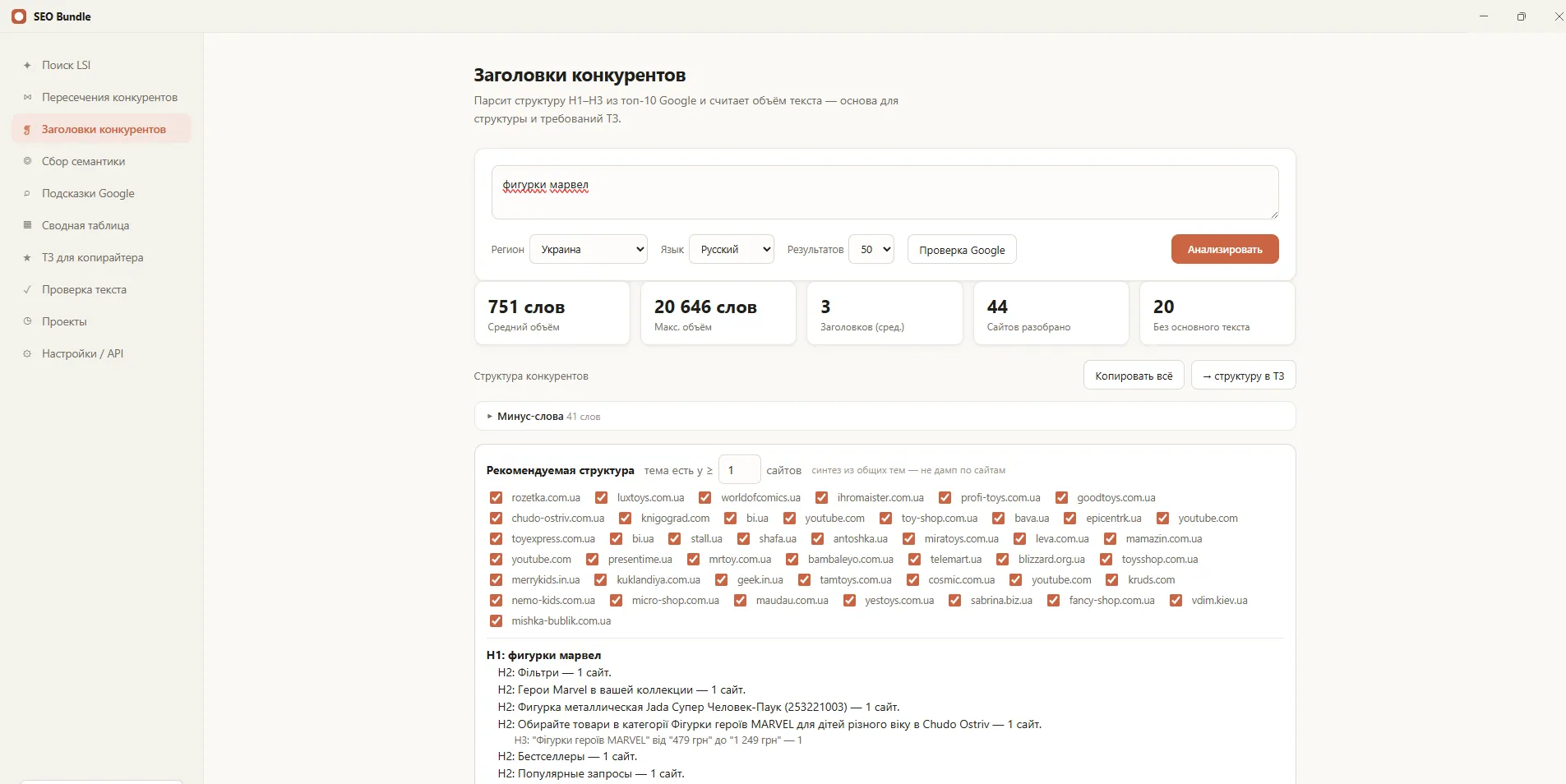
A competitor headings parser is the automatic collection of the H1–H3 structure from pages in the top for your query. In the SEO Bundle app it shows what blocks the best texts consist of, which subtopics they cover and in what order. On the basis of this map you build your own structure that closes the intent no worse than the leaders.
Why analyze competitor headings
Headings are the skeleton of a text and a map of its meaning. If pages in the top cover certain subtopics and yours skips them, the text looks incomplete to search. An analysis of competitor headings shows these required blocks before you start writing.
Manually breaking down ten competitors is slow and easy to miss something. Automatic collection of the structure saves time and gives a full picture: which topics occur in the majority and which are points of difference.
How the parser works in the app
Collecting the structure of headings runs automatically in a few steps.
- The app takes pages from the Google top for your query;
- It crawls them and extracts the H1, H2 and H3 headings;
- It brings the structures into a general list by site;
- It shows which subtopics occur among several competitors;
- It passes the structure into the brief.
As a result you see not one example but a summary map of topics across the whole top.
What the heading structure gives
The main value is a list of intents to close. By the headings you can see what users want on a page: specs, comparison, instructions, prices, reviews. This turns into a plan of sections for the future text.
- A map of required subtopics by the top;
- The order and logic of presentation among leaders;
- Ideas for blocks competitors do not have;
- A basis for the H1–H3 structure of your page.
How to use it without copying
Copying competitors' headings is wrong — it is both non-unique and gives no advantage. The right approach is to take the list of covered topics and reveal them in your own words, in your own structure, adding one or two blocks competitors lack. So the page is both full and different from the rest.
That is why the app returns the structure as a reference for analysis rather than as ready text to paste.
Headings as a map of intent
Behind each subheading is a user's question. When sections about price, delivery or comparison repeat in the top, it means the audience wants exactly these blocks. The map of subheadings turns into a list of questions your text should answer.
So collecting subheadings is not about page design but about meaning: which topics are required for the material to count as full. Skipping frequent sections lowers the chance to reach the top even with a good length.
How to build your own plan
On the basis of the collected sections we build a plan for the future text: we take the required topics, add a logic of presentation and lay in one or two blocks competitors lack. This is both completeness and difference at once.
Such a plan sets the skeleton of an article or a service page before writing, so the writer is not distracted by structure and writes to the point right away.
Which pages it helps with
Breaking down the topics of the top helps on any page type: store categories, blog articles, service landings. Anywhere there is competition in the results, a map of the leaders' sections saves time and insures against missing important topics.
How many competitors to analyze
Usually it is enough to break down the first ten of the results: that is the benchmark search aims at. If topics repeat across most of them, there is no doubt about their importance; if they occur in one or two, it is either a point of difference or noise. The app shows the frequency, so telling one from the other is easy.
For broad topics it is useful to look beyond the ten to find rare but valuable blocks. The decision is yours, based on the summary picture rather than a single example.
Part of the brief
The heading structure is one of the blocks that automatically goes into the copywriter brief along with keys, LSI and length. The copywriter sees at once which sections to cover. The same data is used by the seo-text AI agent when it writes text itself.
The analysis itself became more reliable: pages in windows-1251 and koi8-r encodings are read correctly, without mojibake in H1–H3, and sites that return a 403 to a fake Googlebot are read by a real browser. Loaded pages are reused by other tools through the shared crawl, so structure analysis does not download the top again for every tab.
How it differs from manual analysis
Manually collecting the headings of ten competitors is half an hour to an hour of clicks and copying. The app does it in minutes, brings the structures together at once and highlights shared topics. You get a ready map rather than scattered notes by site.
How to start
The competitor headings parser is one of the functions of the SEO Bundle desktop app. Download the app on the home page and break down the top for your first query in a couple of minutes. For questions about adoption in a team, write to us on Telegram.
Frequently asked questions
Why look at competitor headings?
They show which subtopics pages in the top cover. By closing the same intents in your own words, you make the text full and competitive by content rather than by length.
Where does the app get headings from?
It crawls pages from the Google top for your query and extracts their H1–H3 structure. The result is brought into a general list by site for convenient comparison.
Can I copy competitors' structure?
Copying is not worth it: you need to take the list of topics and reveal them your own way, adding your own blocks. The app gives the structure as a reference rather than ready text to paste.
Is it a separate tool or part of the brief?
Both: the structure can be viewed separately or received within the brief along with keys and LSI for one topic. It depends on how you prefer to work.