
App tool
LSI keyword tool
We extract meaningful words from the Google top for your topic: a clean LSI list that makes text full and natural for search.
Download the app
Windows, macOS, Linux · v0.2.0
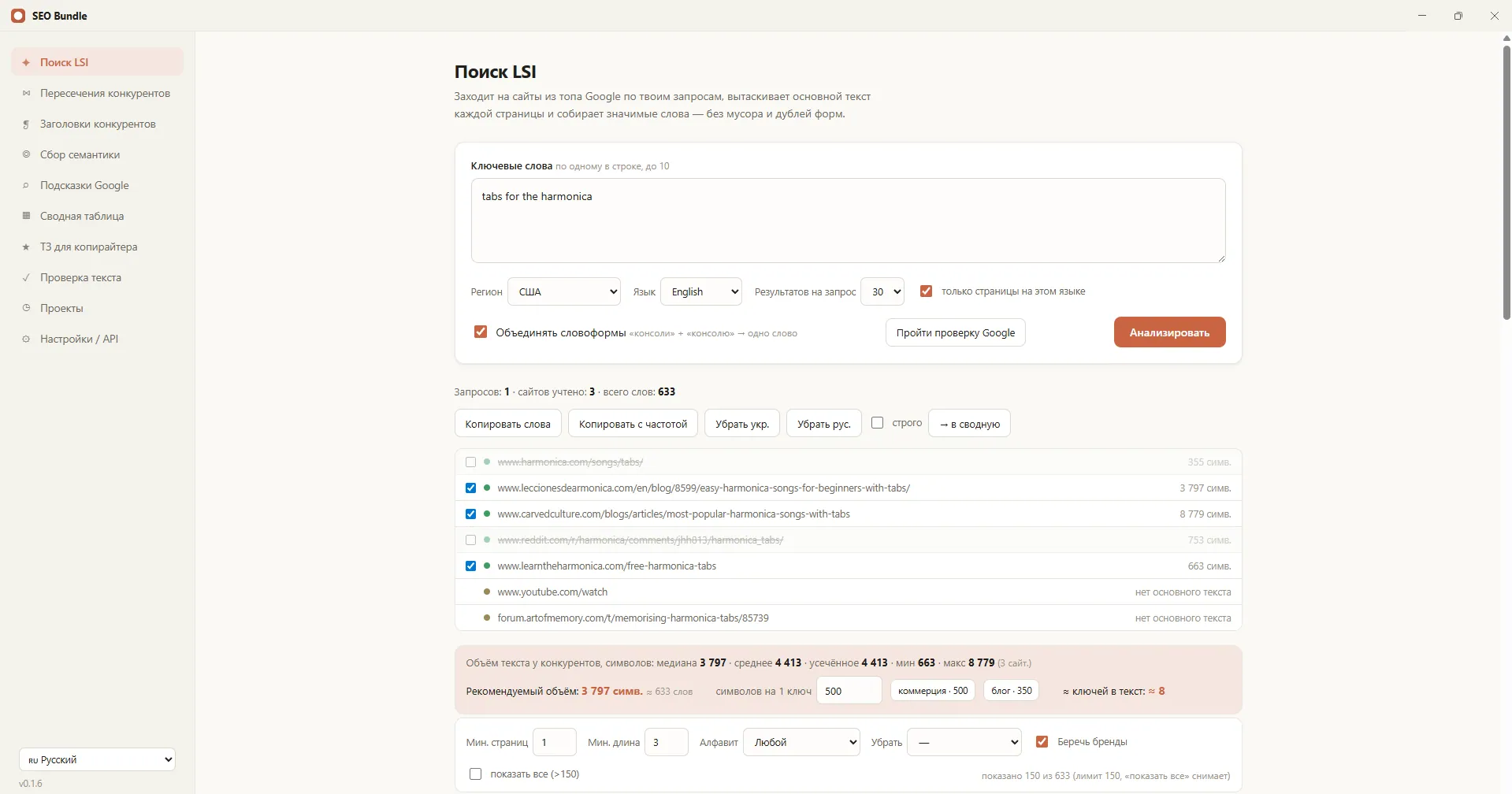
An LSI keyword tool extracts the meaningful terms and expressions used by the sites in the top for your topic. In the SEO Bundle app it is automatic: the pipeline crawls the Google top, pulls the important terms by frequency and clears the noise. The result is an LSI list that makes text full and natural for search.
What LSI is and why it matters
LSI is thematically related words by which search understands that a text really covers a topic rather than just contains a key. A page about "laptops" without the words "processor", "battery", "screen" looks incomplete both to a user and to the algorithm.
LSI copywriting raises relevance without keyword stuffing: instead of saturating the text with one phrase, you cover the topic naturally. This is both safer and more effective for modern algorithms.
How it works in the app
The selection of LSI words in SEO Bundle is built on analysis of the real top rather than on abstract dictionaries.
- The app collects competitor pages from the Google top;
- It extracts meaningful words with priority by occurrence (df-first);
- It filters stop words, noise and duplicate word forms;
- It removes foreign-language words through a dictionary filter;
- It outputs a clean LSI list for the text.
So you get LSI keys that really occur among the leaders rather than a random set of words.
What you get
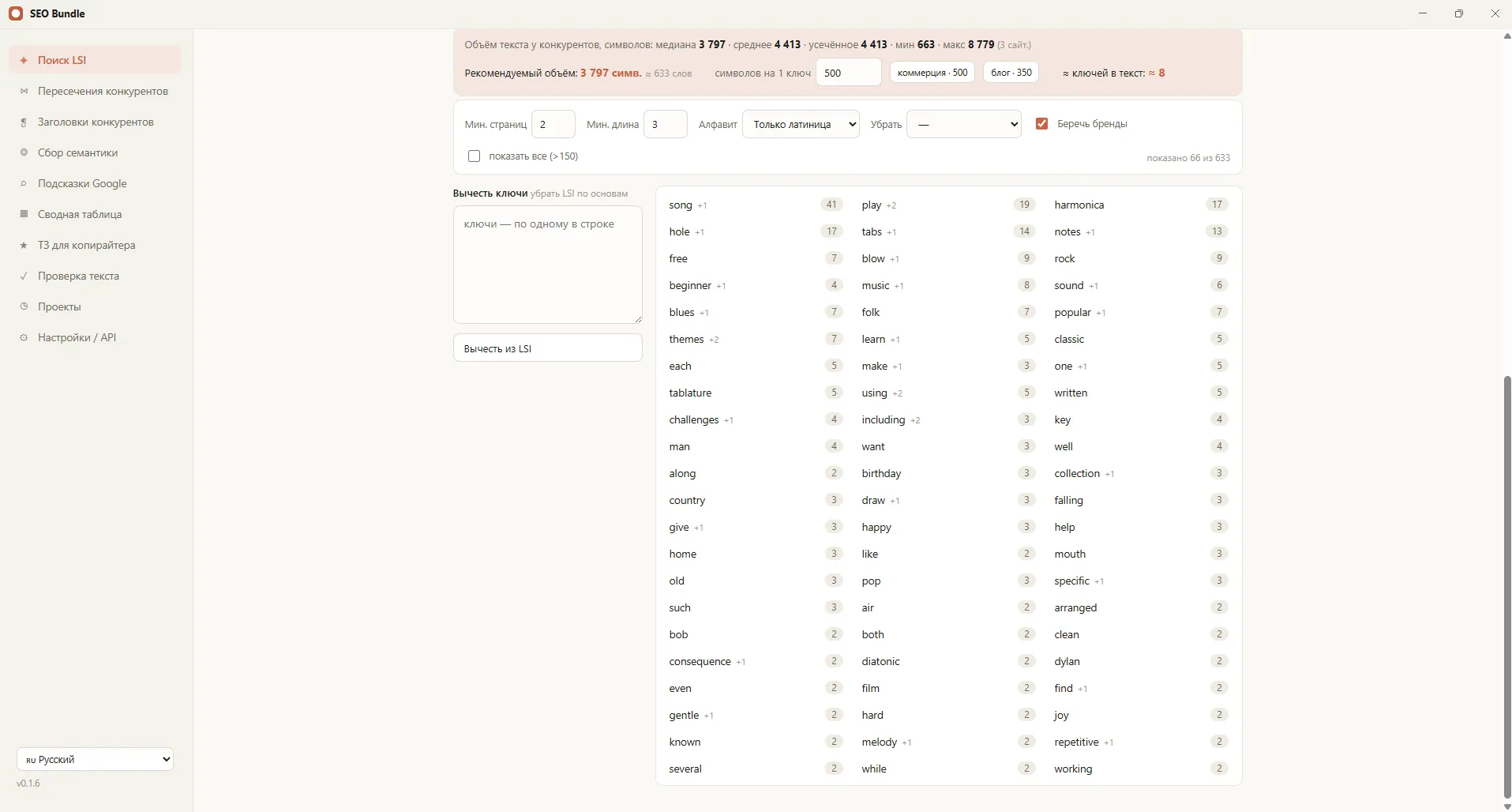
At the output is a ready-to-use set of thematic concepts with no manual cleaning. It can be handed to a copywriter at once or pasted into a brief. Thematic phrases help to cover a topic evenly and avoid filler.
- Meaningful words from the top texts for your topic;
- Priority by occurrence frequency among competitors;
- No stop words, duplicate forms or foreign language;
- Ready to paste into a brief or text.
LSI in copywriting
Using thematic words is simple: write them into meaningful sentences with facts rather than as a comma-separated list. It is enough to cover most of the list once or twice, evenly across the text. This raises the topical completeness that both a reader and search value.
Example: how meaningful words change a text
Imagine a text about choosing a coffee machine with no words like "grind", "pressure", "milk frother", "maintenance". Formally it is about coffee machines, but to search it looks shallow. Add these thematic words — and the page starts answering the buyer's real questions, while the algorithm sees the depth of topic coverage.
This is exactly what the set suggests: which concepts to mention so the text is full. It is important to write them into meaningful sentences rather than list them in a comma string at the end of a paragraph.
The link with keyword stuffing
Texts used to be saturated with one key phrase to the point of unnaturalness and fell under filters. Thematic words solve the task differently: relevance grows through topic completeness rather than repeats. This is a safe path to high positions with no risk of over-optimization.
So a modern text is built around meaning and related concepts, while the key is used in a natural form only a few times. A clean set of thematic concepts helps keep this balance.
Where the data comes from
The source is real pages from the top for your query rather than a general dictionary. The app analyzes the leaders' texts, counts which words occur in several of them and selects the most telling. This approach ties the result to a specific topic and region.
Thanks to filtering by language and forms, the list stays clean: no stop words, noise or repeats in different cases.
Where it helps most
Thematic concepts matter especially on competitive commercial pages and in expert articles, where deep materials hold the top. On such topics a shallow text does not climb higher, no matter how many keys you add.
For an online store these are category descriptions, for a service site service pages and a blog, for a content project reviews and guides. Anywhere you need to prove completeness of topic coverage, a pre-collected set of related terms helps.
How it differs from online services
Many services output LSI from general databases detached from the real results. SEO Bundle takes words from the current top for your query, so the list is relevant to your topic and region. Plus everything works locally, with no limits or a fee per request.
Part of SEO Bundle
The LSI keyword tool is part of the pipeline that prepares the copywriter brief: LSI goes into the brief at once along with keys and structure. The same engine is available as the seo-text AI agent, which writes the text with LSI in mind.
The words found are sent to the shared collection table, where they are cleaned and grouped with the rest of the core. A click on a word shows which top pages it appeared on, and a click on a site address copies the full URL — handy for checking context. Crawling is shared across tools: loaded competitors are reused, and the same pages are not downloaded again for every tab.
How to start
The LSI keyword tool is one of the functions of the SEO Bundle desktop app. Download the app on the home page and gather a set of thematic words for your first topic in a couple of minutes. For questions about adoption in a team or agency, write to us on Telegram.
Frequently asked questions
What are LSI phrases in simple terms?
They are thematically related words that occur among the sites in the top for your topic. They show search that a text covers the topic fully rather than just contains a key in a few places.
Where does the app get LSI from?
From competitor texts in the Google top for your query. Words are extracted by occurrence frequency and cleared of noise and foreign language, so the list is relevant to the topic.
How many LSI should be used in a text?
It is enough to cover most of the list once or twice, evenly across the text and in meaningful sentences. The main thing is not to turn it into a comma-separated list.
Is the LSI tool paid?
It is a function of the SEO Bundle desktop app and works locally with no separate fee per request. Only a Serpstat key is needed to gather semantics at other stages of the work.